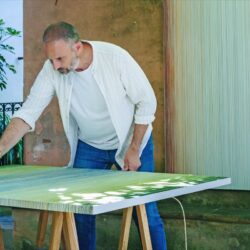
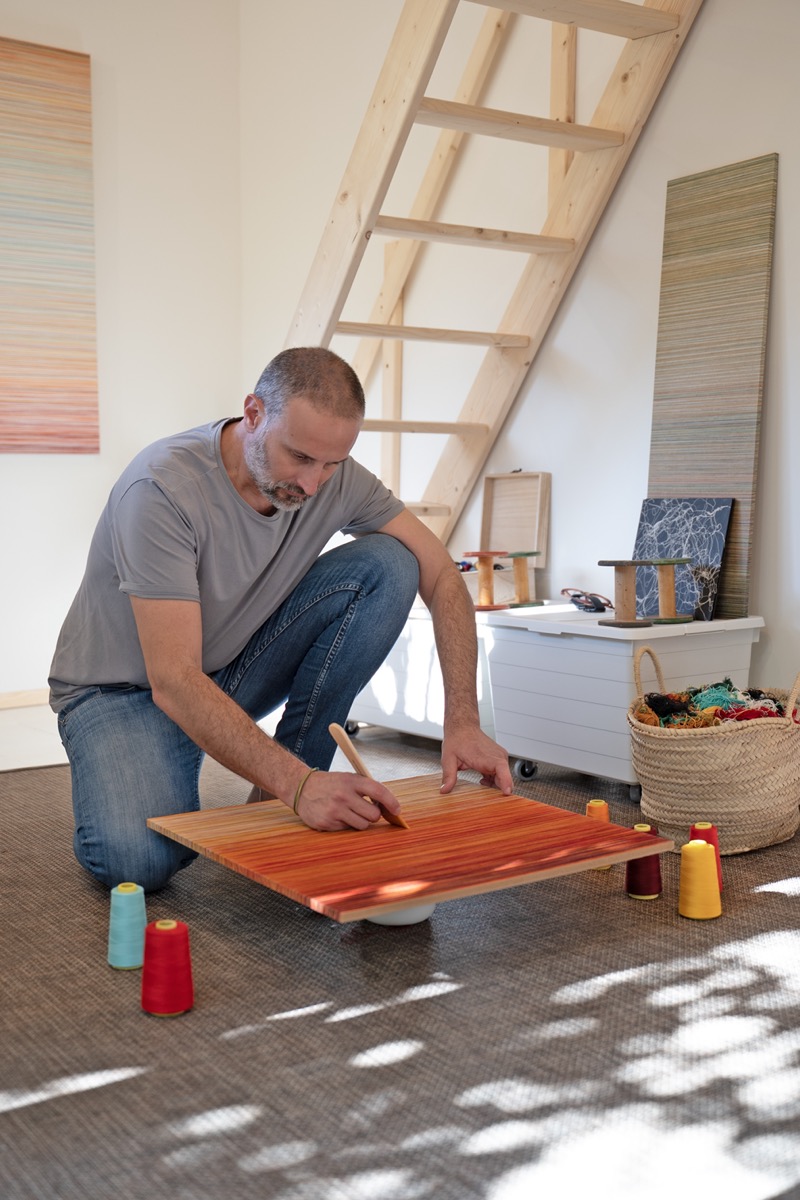
“From a very young age, I felt that art was a way of being in the world — a way to ask questions and sit with quiet moments,” says Toni Garau. The Sóller-born artist doesn’t work with brushes or oil paint, but with thread — long strands of recollection, colour and meaning embedded onto canvas. What began as a symbolic tribute to the women of Mallorca’s textile industry has become his signature language, weaving visual poetry through repetition, tactility, and slowness. In Garau’s hands, thread becomes pigment and movement, capturing what often goes unsaid and unseen. His work resists haste, inviting us to slow our gaze, to feel more than we interpret, and to enter into a quieter, more intuitive form of connection.
A language of memory
Trained in industrial and graphic design, Toni Garau’s path to textile art was gradual. The turning point came in 2010 while researching Sóller’s industrial history for a publishing project. “Through documents, images and testimonies, I discovered the profound impact of the textile industry on the life of the town, especially the silent but essential role of so many women who worked in the factories,” he recalls. That moment marked the beginning of a shift. He began incorporating thread into his pieces as a symbolic gesture. “What began as a discreet detail soon became the central element of my language.”
Garau now uses antique threads, factory ledgers and wooden bobbins — elements once deemed obsolete — and gives them renewed resonance. “I felt called to recover that energy through art… many people recognise something of their own stories in my work, something that connects them with their grandmothers, their childhood, their identity.”
His works are not literal depictions, but visual translations of quietness, shared pasts, and presence. “Thread, with its fragility and history, offered me a way to narrate through the senses, through touch, texture, and emotion.”
Working slowly, living slowly
For Garau, the way a piece takes shape is as essential as the work itself. “Patience isn’t an obstacle; it’s the tempo needed for meaning to emerge,” he says. He works in stillness, with no music and no distractions, guided by a colour, a light, or a feeling not yet fully formed. “I do a lot of observing and researching before I begin a piece; I take my time to breathe.”
Thread becomes his medium, creating subtle textures and tonal shifts. “I combine threads as if I were mixing pigments, creating physical nuances that shift with the changing light.” The work unfolds at its own pace, and so too does its viewing. “Slowness is part of the message: my work isn’t consumed quickly. It invites the viewer to stay, to look differently.”
Mallorca’s natural beauty, especially the Tramuntana mountains and winter sunsets, plays a key role in his palette. “Mallorca is in my creative DNA. I couldn’t work the same way without this sun, this sea, the presence of the Tramuntana,” he says.
His LLUM series explored illumination as a subject and material. “In Mallorca, light isn’t neutral. It has an intensity that reveals everything, but also a softness that allows for contemplation.”
His current series, Memorias en Trama, transforms old textile factory ledgers into thread-intervened compositions. “The archive, rather than being a cold record, becomes a living body that holds traces, impressions, and silences,” he says. These works transform forgotten factory records into poetic artefacts, preserving stories that have long been overlooked.
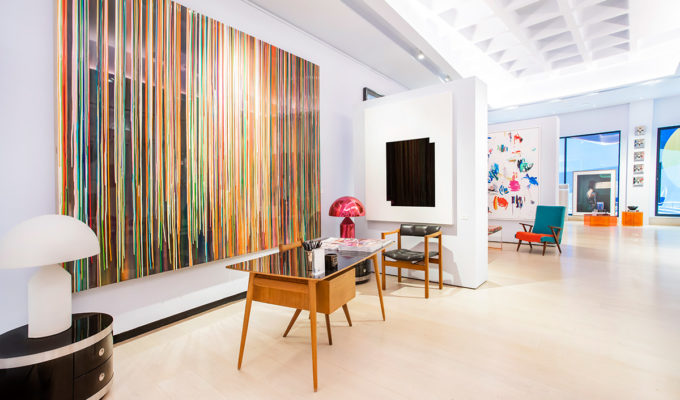
Exhibited permanently at Gallery RED in Palma, Garau’s pieces continue to evolve. Yet they always remain grounded in slowness, sensitivity, and the quiet force of remembrance. He draws us into a subtler kind of seeing, where feeling, intuition, and forgotten moments softly surface.